


Steve McConnell, CFP®
Founder of Rain Dog and author of Code Complete—bringing empathy & engineering to financial planning
Financial Planning | Investments | Taxes
If you have $3–$10 million or more in investments, how can you tell whether your financial advisor is providing the level of wealth management you should expect?
As household net worth scales up, some of the financial planning focus remains the same as what’s needed for more typical households, and some changes. Differences concentrate in three main areas:
- Asset complexity
- Compensation complexity
- Tax exposure
Affluent households should expect substantial support from a high net worth financial advisor in each of these areas.
Asset complexity
In some cases, a high net worth (HNW) household’s assets will be straightforward and not qualitatively different than a typical household’s. Some people accumulate significant wealth in regular retirement accounts, taxable investments, and real estate.
In other cases, assets may be more elaborate and include business ownership, partnerships, investment real estate, trusts, collectibles, and other less common assets.
Compensation complexity
Sometimes compensation increases to a level that is high but still straightforward. More often, higher levels of compensation include business ownership, equity components from current and past roles, and/or substantial deferred compensation.
HNW households should expect their advisor to provide input and guidance in each of these areas. For example:
- Financial implications of different ownership structures
- Plans for transferring ownership over time to partners or family members
- Planning for equity-based compensation including different types of stock and stock options, concentrated stock positions, effect on taxes, and other related factors
- Guidance on deferred compensation decisions
In addition, HNW households sometimes retire earlier than the general population. Their advisor should be able to develop income plans based on longer-than-average retirement horizons.
Tax exposure
Even if a high level of income is straightforward and high assets are also straightforward, at higher net worth levels, tax rates will be higher than at lower levels.
High net worth wealth management, by its nature, calls for more emphasis on tax planning because a higher percentage of both income and assets are potentially lost to taxes.
These three factors—income complexity, asset complexity, and tax exposure—are cross-cutting concerns. They drive what high net worth households should expect from their financial advisor in each of these five specific areas:
- Fully integrated financial planning
- Portfolio-level diversification and optimization
- Asset location
- Income design
- Strategy for private and alternative investments
Is your financial advisor doing enough? The remaining sections in this Field Note describe the specifics of what HNW households should expect from their advisor.
Fully integrated financial planning
Financial plans should integrate income, assets, and tax exposure. This includes:
- Past—accounting for your investment cost basis in planning, reviewing your tax returns for past tax strategy.
- Present—planning for your full portfolio, including assets not directly managed, K-1 income, the tax consequences of changing past investment decisions; coordinating with your CPA and insurance coverage.
- Future—how your portfolio will evolve over time to generate the lowest taxes, highest income, and/or highest legacy value; charitable goals; coordinating with your estate planner.
HNW households that have not been fully served sometimes perceive the financial advisor’s role as being limited to a set-and-forget asset allocation, possibly with annual rebalancing. The HNW household should expect more, including:
- Adjusting asset allocation and allocations across tax categories when investment assets are sold to purchase real estate
- Adjusting asset and tax allocations when investment assets are purchased in response to a Roth conversion, IRA rollover, or inheritance
- Updating assets as income is withdrawn throughout the year
- Reviewing and rolling bond positions to maintain desired yield and duration
- Revising positions in response to tax law changes
- Acting as a sounding board for major financial decisions
- Providing guidance when the market turns choppy to explain how your portfolio has been designed for down cycles as well as up cycles (assuming it is)
Integrated financial planning for HNW households is an ongoing partnership, not just a one-time financial plan.
Signs that you’re getting this
You should receive a financial plan that explicitly optimizes across competing objectives. Different HNW households have different priorities for income, taxes, and legacy values. These priorities interact, and a sound plan will account for those interactions and tradeoffs according to your personal priorities. See an example of an integrated financial plan.
You should receive a view of future years that shows, in detail, future cash flows, income, taxes, asset values, and ultimate estate value. A view such as a pro forma financial statement supports coordinating with other professionals such as CPAs and estate planners.
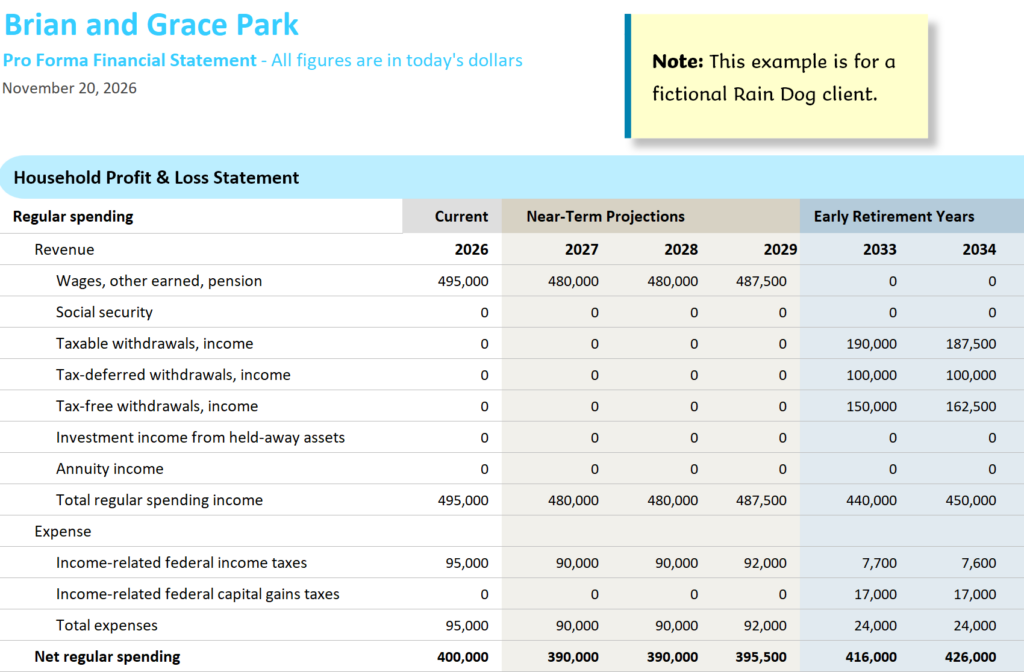
A pro forma personal financial statement shows how cash flows and asset values change over time. Click the image to see the full financial statement.
You should receive regular communication from your advisor and feel that your financial advisor understands your goals. If you call in and your advisor says, “Remind me again how to spell your last name?” you’re probably not receiving the support you deserve.
Portfolio-level diversification and optimization
Your portfolio should be mathematically optimized, broadly diversified, and appropriate for your level of wealth, risk tolerance, investment horizon, and life goals.
Your advisor should be able to explain your portfolio’s expected level of return, overall risk, and downside exposure. Your advisor should be able to explain what alternatives were considered and how the recommended approach supports your financial objectives. See Rain Dog’s approach to portfolio design.
Your investment portfolio should be fully integrated across your entire household just as your financial plan is.
Your investment plan should account directly or indirectly for all your assets, including business ownership, personal real estate, investment real estate, concentrated stock positions, and alternatives, in addition to traditional ETFs, mutual funds, and individual stocks and bonds.
What you should not expect from your financial advisor is stock picking that outperforms the S&P 500. Research has shown for decades that most individual fund managers underperform their risk-adjusted benchmarks over time. For example, the 2025 SPIVA U.S. Scorecard from S&P Global found that 96% of actively-managed US equity funds underperformed their risk-adjusted benchmarks over a 10-year period.
Signs that you’re not getting this
We see five common failure modes in this area.
The first failure mode is not considering held-away assets in portfolio optimization. Assets such as business ownership and investment real estate might not lend themselves to mean variance optimization, but all of your assets should be considered qualitatively, even if they can’t be considered quantitatively.
The second failure mode is investing heavily in funds and stocks that overlap in their underlying holdings, such as holding VOO, VTI, QQQ, NVDA, and MSFT all in the same portfolio. This looks somewhat diversified but replicates magnificent seven concentration across all holdings.
The third failure mode is holding most of the portfolio in one type of direct indexing, for example, holding most of the portfolio in an S&P500 or large cap direct index fund. A well-designed portfolio consisting of 5-10 ETFs can easily be better diversified than a direct-index portfolio containing several hundred individual stocks.
The fourth failure mode is putting you into pre-defined model portfolios, e.g., CIO portfolios, rather than customizing a portfolio specifically for you. This one is hard to detect and is perhaps most visible in conjunction with the next topic.
The final failure mode is not considering tax consequences of transactions. We’ve heard horror stories of advisors who restructure investments in a new client’s taxable account with no awareness of tax consequences and who rebalance as frequently as monthly with no apparent awareness of tax consequences. A good advisor will holistically weigh the tax implications of changing low-cost-basis taxable positions as part of overall portfolio design and management.
Asset location
Taxes take a bigger bite at higher income and asset levels, and the tax design of your portfolio should be considered as carefully as the asset allocation.
Assets should be placed into tax categories based on quantitative long-term tax exposure, not just based on rules of thumb.
HNW households sometimes want to offload tax planning to a professional but retain the investment management themselves. When done well, comprehensive financial planning involves integrating investment planning and tax planning on an ongoing basis. The two disciplines are so intertwined that it’s impractical to treat them as separate activities.
If you aren’t receiving tax planning as a HNW household, a big piece of what you should be getting from your wealth manager is missing. See Rain Dog’s approach to investment tax planning.
Signs that you’re getting this
If your portfolio looks very similar across taxable, tax-deferred, and tax-free holdings, you are probably not getting this. If your advisor has put you mostly into ETFs and mutual funds, and those look mostly similar across tax categories, that can signal both a lack of tax planning and the third failure mode above—putting you into predefined model portfolios.
If your advisor is using direct indexing, that can obscure whether meaningful asset location work has been done, because the level of detail makes it difficult to determine exactly how your holdings in different categories vary, or if they vary at all.
With tax-efficient asset location, holdings will look noticeably different in different tax categories. Indeed, a well-designed asset location plan can look eccentric at the individual account level.
Your advisor should be able to show you a quantitative comparison of alternative asset location strategies. This will necessarily involve assumptions and estimates and will not be exact. The future is uncertain, but there should nevertheless be a clear attempt to do the best job possible with the information that’s available at the time.
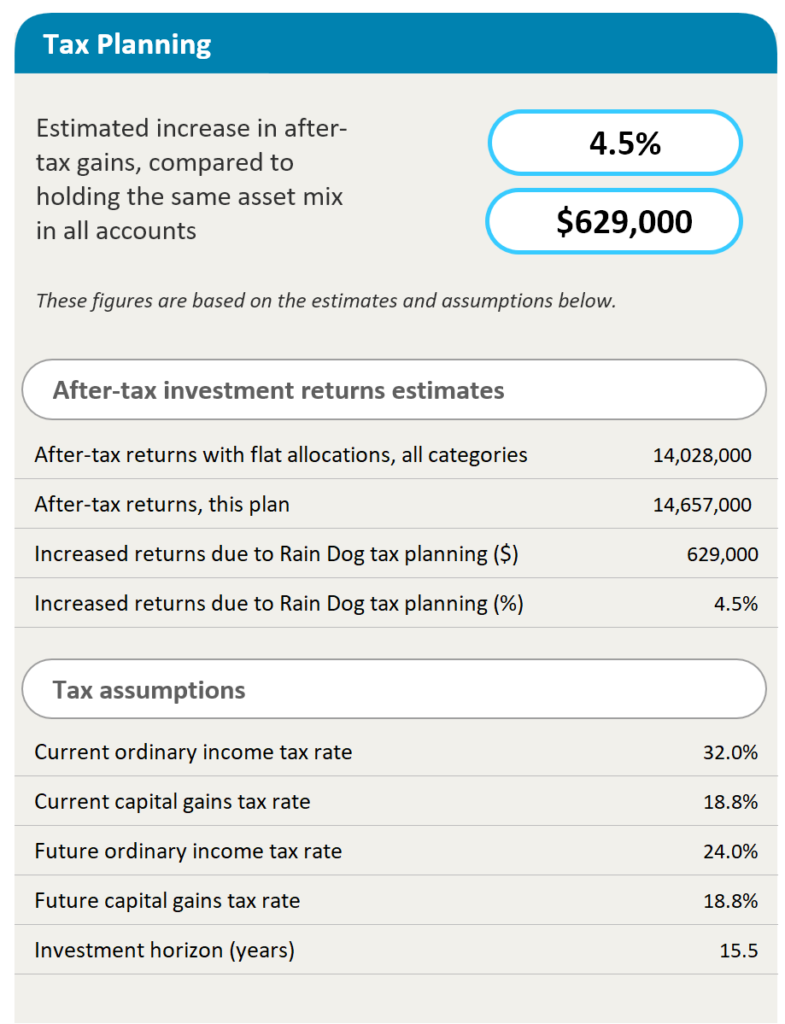
A tax-efficient asset location plan should evaluate placement options quantitatively. This will require making assumptions and estimates about asset growth rates and current and future tax rates. Click on the image to see the full example, which illustrates how the allocations to tax categories—in isolation—can look eccentric in a tax-efficient location plan
Income design/spending design
HNW households typically have enough assets across different tax categories that income can be sourced in tax-efficient ways.
In this context, we need to be clear what we mean by the word income. What I mean is money that’s used for spending. In other words, cash flow. Income design is only peripherally related to holding income stocks or bond funds that generate interest.
A well-designed income plan is integrated with both investments and taxes—it minimizes taxes and avoids having to sell growth assets during market downturns.
Social security and Medicare planning also matter, even for HNW households. Social security payments won’t provide the bulk of a HNW household’s retirement income, but high lifetime earners also receive relatively high social security benefits, and the forced income from social security payments ripples through tax planning for other income. Similarly, accounting for the step-function nature of income-based Medicare payments (IRMAA) can result in a step-function increase in taxes unless IRMAA consideration is integrated into income planning.
An income plan should also be a plan. It should account for major cash flows, onset of social security, anticipation of RMDs, how to respond to market downturns, college funding, cash inflows or outflows for real estate transactions. We see a lot of emphasis on using simple heuristics like the 4% rule as a north star for spending, but that’s just a simple percentage, and a percentage is not a plan.
Signs that you’re getting this
You’re able to see where your spending is coming from 2-4 years ahead of when you need it. You can see how you’ll cover planned spending without selling growth assets, and you’ll see the tax implications of the whole sequence.
Strategy for private and alternative investments
HNW investors have access to types of investments that are not available to lower net worth investors. This includes access to some kinds of private equity, private credit, real estate partnerships, and other private offerings.
Private investments offer access to opportunities that aren’t available in public markets, including access to growing private companies, specialized real estate projects, and private lending. They can provide additional diversification, sometimes with low correlation to public assets, and potentially higher returns than publicly traded investments.
These potential benefits come with tradeoffs, including higher fees, less transparent valuations, and sometimes substantial restrictions on when investors can sell their holdings.
The fact that it’s possible to hold a certain type of investment doesn’t mean that more is better. A cohesive strategy should come first, and specific holdings—appropriately sized and consistent with the strategy—come second.
Sophisticated wealth management does not simply consist of holding private and alternative investments.
Signs that you’re getting this
Most of your investments are in highly efficient index funds. Investments in alternatives are sized appropriately for your total level of wealth, life stage, risk tolerance, and income and legacy goals.
Signs that you’re not getting this
Many of your investments are in private equity, private credit, or investments that can only be obtained through one RIA firm (and that create problems if you ever want to change firms).
Conclusions
HNW investors sometimes feel that the main benefit they received from their advisor is access to types of investments that aren’t available to retail investors. That might truly be a benefit, but it’s probably the lowest value benefit on the list.
More significant benefits include holistic portfolio strategy across all holdings, explicit tax strategy, appropriate sizing and selection of exotic investments, coordination with CPAs and estate planners—and integration of all the above.
Whether you’re selecting an advisor or evaluating your existing relationship, ask to see evidence of the planning and management behind the investment recommendations. You should understand not just what you own, but why you own it, how it affects your taxes, and how it fits into your long-term financial plans.
