


Steve McConnell, CFP®
Founder of Rain Dog and author of Code Complete—bringing empathy & engineering to financial planning
Bonds | Investments
This week Vanguard released the quarterly updates for its model portfolios. Of particular interest was its Capital Preservation portfolio. You can see the performance numbers here.
Most notable to me was the fact that Vanguard’s Capital Preservation portfolio did not preserve capital in 2026Q3. It recorded a -0.05% loss for the quarter. It was a minor loss, but the reasons it lost any value at all are worth examining.
The table below shows the composition of Vanguard’s portfolio.
| Fund | Ticker | Weight | 2026Q3 Return | Duration |
|---|---|---|---|---|
| Ultra-Short Bond ETF | VUSB | 19.6% | 0.64% | 0.9 years |
| Short Duration Bond ETF | VSDB | 8.9% | -0.99% | 2.6 years |
| 0-3 Month Treasury Bill ETF | VBIL | 4.9% | 0.92% | 0.1 years |
| Short-Term Treasury ETF | VGSH | 64.6% | -0.18% | 1.8 years |
| Cash | – | 2.0% | 0.97% | – |
The problem that Vanguard’s capital preservation portfolio encountered in 2026Q3 is that interest rates increased enough to deflate bond prices even with the portfolio’s short average duration of 1.6 years and most of its investments in government bonds. Investors who were invested in Vanguard’s Capital Preservation model portfolio on September 30, 2026 found that they did not have 100% of the money they started with on July 1, 2026. That portfolio did not preserve capital.
Vanguard’s Capital Preservation portfolio is no worse than many other capital preservation portfolios I’ve seen. In various periods, some of these other portfolios have also failed to preserve capital. From 2021-2022, iSectors’ Capital Preservation model lost 4.27%. In 2022, Envestnet’s PMC Capital Preservation portfolio lost 12.68%. iM Global Partner’s iMGP Capital Preservation ESG portfolio lost 13.69% for the year ending 10/31/2022. Justwealth’s U.S. Capital Preservation portfolio lost 2.01% for 2026Q3 and was down 0.72% from January-September 2026.
The root problem is not specific to any one portfolio; it is endemic to the traditional approach to capital preservation.
Engaged without a date and without a ring is not engaged
When I was younger, one of my friends got engaged to his girlfriend, but there was no engagement ring and no wedding date. Our other friend kept saying, “Engaged without a ring and without a date is not engaged. You have to have one or the other or you aren’t engaged.” That went on for months. Eventually, the couple got a ring, set a date, and got married.
Capital preservation involves a similar concept.
Capital preservation without a date and without cash is not capital preservation.
In finance, there are only two ways to achieve true capital preservation:
- Define a date as of which the capital must be preserved
- Invest in cash
If your capital preservation portfolio doesn’t have at least one of these properties, you cannot be assured at any particular time that capital will be preserved.
Note: for purposes of this article, “cash” is assumed to be invested in a money market account that keeps pace with inflation.
Outperforming cash
The simplest approach would be to keep all the capital you need to preserve in cash. The limitation of that strategy is that cash earns a low return.
To increase returns, the finance world includes other investments in their capital preservation portfolios, but once even a single step is taken away from cash, the investments become subject to risk. In particular, bonds are subject to interest-rate risk: if interest rates go up, bond prices go down, and capital is not preserved. Usually higher yields and longer durations go together, but the longer the bond’s maturity is, the more interest-rate risk it’s exposed to.
The finance world walks a tightrope between short duration, which provides a higher chance of capital preservation, and longer duration, which is needed to outperform cash. Different capital preservation portfolios strike different balances. T. Rowe Price’s capital preservation portfolio invests 80% in cash, whereas Vanguard’s capital preservation portfolio invests only 2% in cash and relies mostly on short-term bond funds. Of the portfolios I’ve seen, most are more similar to Vanguard’s model than T. Rowe Price’s.
Capital preservation without a date and without cash is not capital preservation, and most portfolios emphasize non-cash investments. That means to achieve capital preservation, they need a date at which the capital will be preserved, but that is not what they have.
Traditional capital-preservation portfolios make their non-cash investments in short-term constant-horizon bond funds. Constant-horizon bond funds maintain a fixed duration; there is no date at which the bonds in the fund all mature. These funds are like ships at sea that never pull into port. There is never a specific time when the bonds reach maturity and the investor knows they can count on their investment reaching a particular value. The result is failure to achieve capital preservation.
What happens with a date
In the academic literature, a “riskless asset” (the type you would use for capital preservation) is horizon-dependent. A 3-month T-bill is riskless for 3 months, not 10 years. If you want a riskless asset to use 10 years from now, you buy a government bond that matures in 10 years.
Investors who want both capital preservation and a higher return than cash must introduce the concept of a date, meaning, a date at which capital will be preserved.
Vanguard recently released the quarterly update for another model portfolio, its 0-3 Year Target Maturity Corporate Bond portfolio, which you can see here. Vanguard’s target maturity offerings are new this year and do not include a 2026 target maturity ETF.
Supplementing Vanguard’s target maturity offerings with a 2026 target maturity ETF from Invesco, the laddered target maturity structure that Vanguard uses would look like this:
| Fund | Ticker | Weight | 2026Q3 Return | Duration |
|---|---|---|---|---|
| Invesco 2026 target maturity fund | BSCQ | 33.3% | 0.96% | 0.1 years |
| Vanguard 2027 target maturity fund | VBCA | 33.3% | 0.75% | 0.7 years |
| Vanguard 2028 target maturity fund | VBCB | 33.3% | 0.01% | 1.8 years |
Vanguard doesn’t refer to this portfolio as a “capital preservation” portfolio, however, this portfolio would have preserved capital in 2026Q3 and would have recorded a gain of 0.57% for the quarter.
The structure of Vanguard’s 0-3 year target maturity date portfolio has three different ETFs, which implies trying to preserve capital for three different horizons. With that structure, each horizon looks like this:
- Now (2026): BSCQ outperforms cash and preserves capital in 2026.
- 2027: VBCA largely locks in a yield and preserves capital as of 2027. In contrast, cash would preserve capital, but returns can fall if rates fall. Constant-horizon bond funds would expose the portfolio to losing value if rates rise.
- 2028: VBCB largely locks in the yield and preserves capital as of 2028. Cash would again be subject to falling rates; constant-horizon bond funds would be susceptible to losing value if rates rise.
For each target period, the target maturity date provides greater certainty about returns and capital preservation, largely independent of what rates do between now and then.
With constant-horizon funds, the investor remains exposed to the effect of rate fluctuations at every horizon, and there is no date at which an investor can have high confidence that capital will be preserved.
How to preserve capital
The chart below compares the performance of the very-short-term ETFs used in the two Vanguard funds and Invesco’s 2026 target-maturity-date bond ETF.
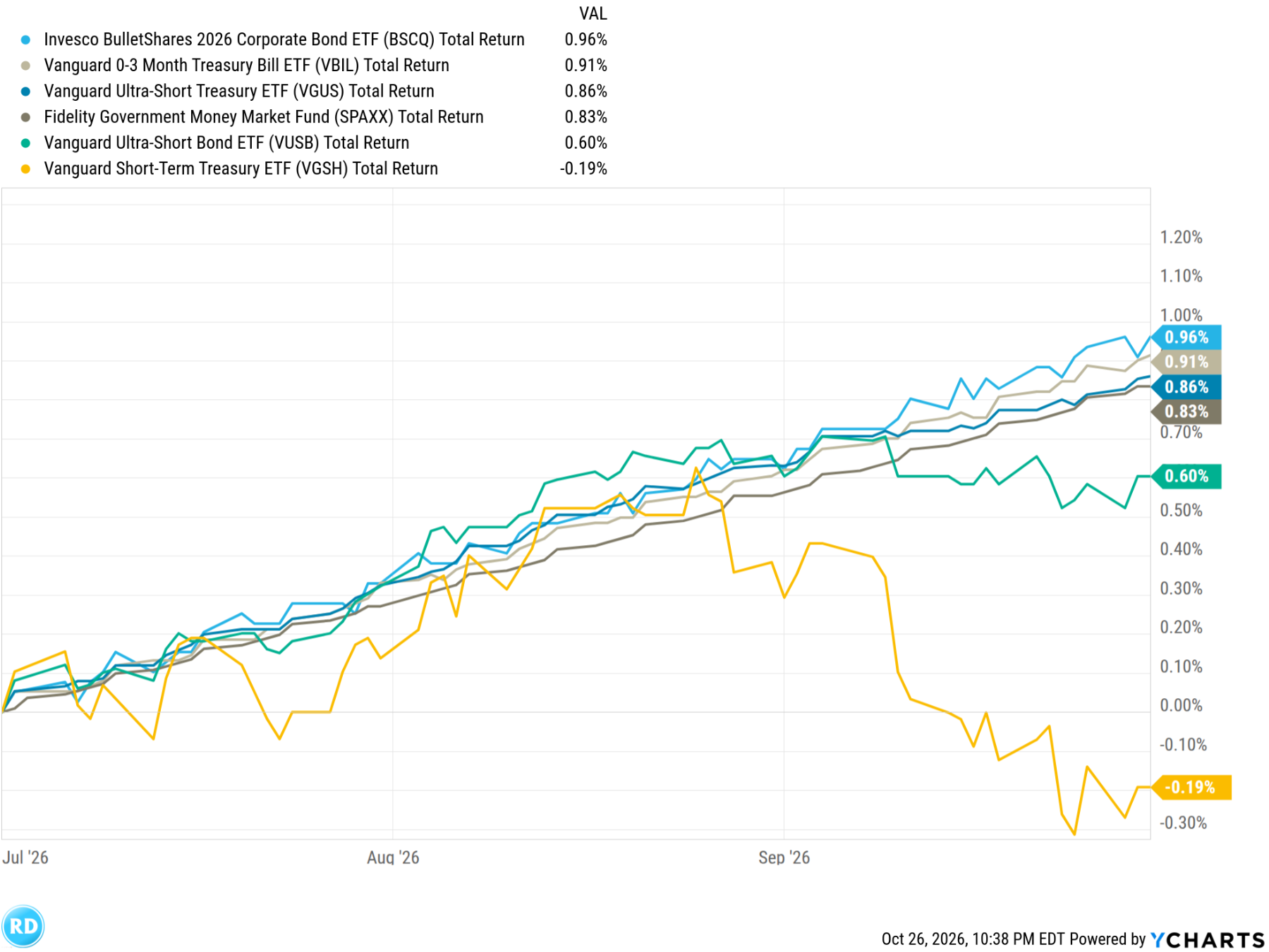
Interest rates rose during 2026Q3; the constant-horizon fund VGSH produced a loss, but the 2026 target-date fund BSCQ held steady. Indeed, BSCQ did better than any other short-term asset over the quarter, including the money market (SPAXX) and 3-month T-bills (VBIL)—while still preserving capital. It returned 0.96% for the quarter compared to 0.83% for Fidelity’s money market fund (cash) and -0.05% for Vanguard’s Capital Preservation portfolio.
Any capital preservation strategy that uses constant-horizon bond funds will be at risk of losing value when interest rates rise, even with very short durations. Even with the modest increase in rates in September 2026, many ultra-short duration funds lost value for the month, as shown here:
| Ticker | Fund | Total Return | Duration (Years) |
|---|---|---|---|
| DUSB | Dimensional Ultrashort Fixed Income ETF | -0.15% | 0.87 |
| FUSD | Federated Hermes Ultrashort Bond ETF | -0.13% | 0.90 |
| GUMI | Goldman Sachs Ultra Short Municipal Income ETF | -0.11% | 0.53 |
| JMST | JPMorgan Ultra-Short Municipal Income ETF | -0.58% | 0.77 |
| TSDUX | Morgan Stanley Pathway Ultra-Short Term FI | -0.05% | 0.33 |
| GSY | Invesco Ultra Short Duration ETF | -0.05% | 0.78 |
| TRBUX | T. Rowe Price Ultra Short-Term Bond Fund | -0.04% | 0.63 |
| VUSB | Vanguard Ultra-Short Bond ETF | -0.05% | 0.90 |
The conclusion is not that these specific funds are bad; it is that short duration does not ensure capital preservation. Of 499 bond funds listed by YCharts as having positive effective durations of 1.00 years or less, 46% lost value in September. Of 272 funds with effective durations of 0.50 years or less, 38% lost value. Of 57 funds with effective durations of 0.10 years or less, 32% lost value. Even ultra-short duration in a constant-horizon fund does not ensure capital preservation.
Conclusions
The traditional approach to the capital-preservation portion of investors’ portfolios suffers a significant flaw, which is the use of constant-horizon bond funds.
We saw only a quarter-point increase in interest rates in September 2026, yet even ultra-short duration bond funds dropped in value, which caused capital preservation portfolios like Vanguard’s to drop in value too.
Some decreases in value were minor, but that really isn’t the point. The point is that there is no date at which an investor can know that a constant-horizon portfolio will preserve capital.
A better approach to preserving capital relies on introducing dates into the equation, and target-maturity-date bond ETFs are an effective tool for doing that.
Important information about this Field Note. This Field Note is for informational purposes only and does not constitute individualized investment, tax, or legal advice. Past performance is not a guarantee of future results, and rates may change.
Historical return data is from Envestnet, iSectors, iM Global Partner, Justwealth, Vanguard, and YCharts. Returns cited from different sources may differ slightly due to different calculation methodologies.
