


Steve McConnell, CFP®
Founder of Rain Dog and author of Code Complete—bringing empathy & engineering to financial planning
Investments | Taxes
Judicious asset location (aka tax location) is as close as a household can get to a free lunch in the investment world. Two households with identical holdings can end an investment horizon with materially different after-tax account values purely because of where each asset was held. The higher after-tax values can be achieved with no change in overall allocation and no additional investment risk—just by changing the tax status in which each asset is held.
Over the past few years, I’ve reviewed account statements from many of the major brokerage houses as well as investment advisory firms. I’ve seen numerous elaborate financial statements that run 100-200 pages or more. What I haven’t seen is any apparent attempt to place assets in tax locations that benefit the investor.
What I’ve seen instead—near universally—is a peanut-butter spread of all assets across all account types. Meaning, same basic assets in taxable, IRA, and Roth accounts. This is a significant missed opportunity, and this Field Note explains how much that matters.
Short version: If you mainly want a sense of how much tax-location planning can help, just read Scenario 1 below or skim the beige Tax Planning boxes at the end of each scenario.
Rain Dog’s approach to asset location
Rain Dog begins with the investor’s overall asset allocation. Then we look at any constraints on where assets must be located, such as assets that are in an active 401(k) plan or taxable assets with low cost basis that would be tax-inefficient to sell.
We then exhaustively estimate the tax consequences of each combination of asset and tax status over the investor’s planning horizon, based on the specific investor’s current and future tax rates. Assets are then placed in the locations that are most tax-advantageous to the household, subject to the kinds of constraints defined above.
For more technical details on Rain Dog’s approach, see Decision Brief: Tax-Efficient Asset Location—Placement Across Tax Categories.
Scenario 1: Brian and Grace Park
Brian and Grace and the other households described here are fictional, but their overall circumstances are representative of the households Rain Dog works with.
Brian and Grace are ages 64 and 55 respectively, they live in Bellevue, WA, and they have total investment assets of approximately $6 million. Of those, Rain Dog directly manages $5.3 million, including $1.5 million in Roth IRAs, $1.3 million in traditional IRAs, and $2.5 million in taxable accounts. Their portfolio is based on a growth-oriented investment plan.
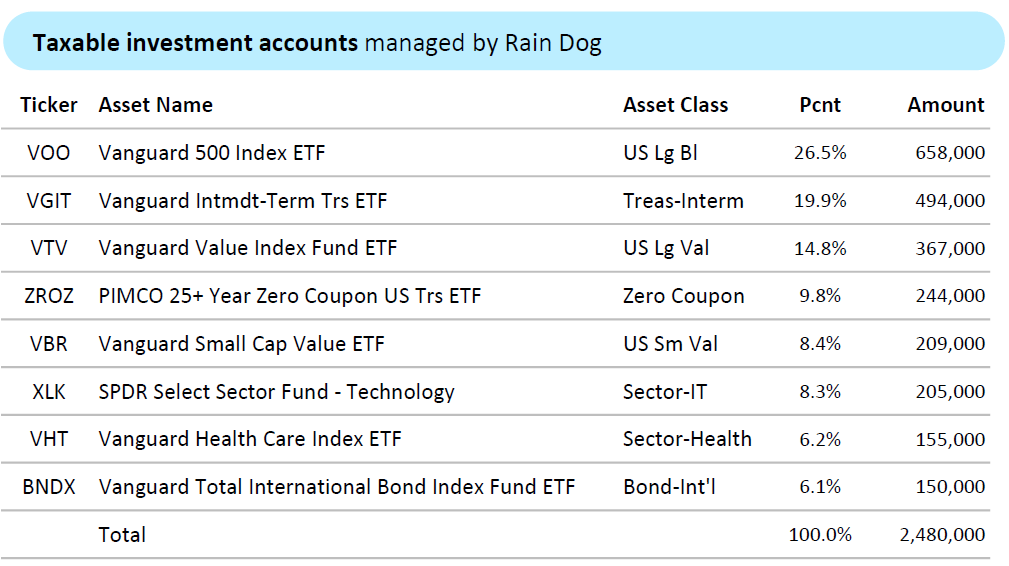
The constraints in managing Brian and Grace’s portfolio are mostly in their taxable account. Brian is working at a startup and has $33,000 in that company’s 401(k). In the taxable account, the household has a few low-cost-basis holdings that would be tax-inefficient to sell: $658,000 in Vanguard 500 Index ETF, $367,000 in Vanguard Value Index ETF, and $205,000 in SPDR Select Sector Fund-Technology ETF.
Brian and Grace’s asset location plan
You can see Brian and Grace’s full asset location plan here.
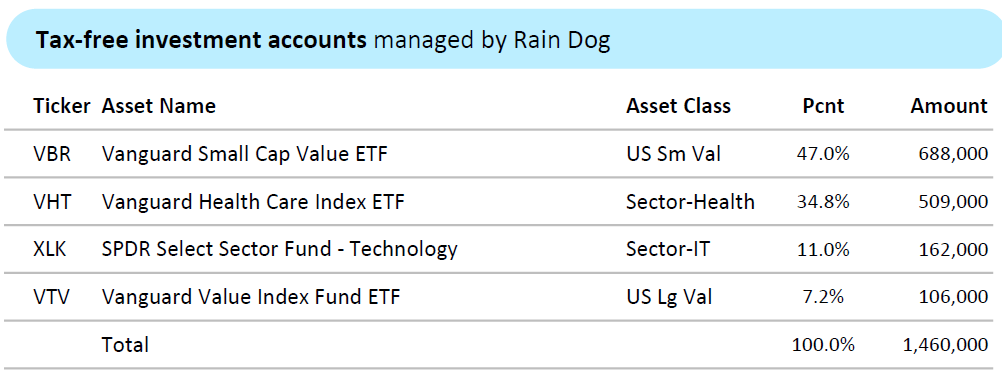
Let’s begin with an overview of how Brian and Grace’s assets are located. Rain Dog’s optimizer places high-growth assets into the Roth account:
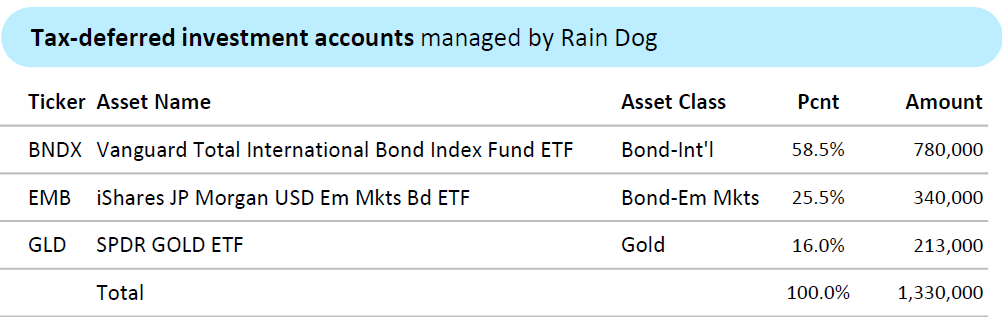
Their IRA includes two bond funds and a gold ETF:
Their taxable account contains their low-basis holdings, additional equity funds and three bond funds:
Observations
Roth (tax-free) placement. Rain Dog’s optimizer begins by calculating which assets benefit the most after taxes by being placed in Roth accounts over the Park’s 17.5-year investment horizon. That results in four high-growth equity assets in Roth.
Why specifically four assets in Roth? If we had perfect knowledge of how each specific asset would perform over the investment horizon, we would put only the one or two highest tax-performing assets into Roth. But because past performance is truly not a guarantee of future performance, we believe there is value in diversifying inside of Roth—in essence, we don’t want to put all our tax-strategy eggs in one basket.
Importantly, this does not affect the diversification of the Park’s portfolio overall. Asset location decides only which tax status is preferable for each asset; overall asset allocation is not changed.
IRA (tax-deferred) placement. A common rule of thumb says that bonds should go into tax-deferred accounts, but Brian and Grace’s bond allocation is too large to fit entirely into their IRAs. The question then becomes which bonds should go into their IRAs?
The first part of the answer is not even a bond. The gold ETF has the worst tax exposure at their future tax brackets, followed by the emerging market bond ETF, so 100% of those assets go into Brian and Grace’s IRAs. The next-most tax-exposed asset is the international bond index fund, which consumes the rest of the capacity in their IRA accounts. The remaining bond holdings go into taxable.
Results of intentional tax location
Rain Dog’s analysis compares the tax efficiency of each candidate asset location against a flat allocation in which all assets are distributed evenly across all tax locations, because that is by far the most common pattern I’ve seen in the statements I’ve reviewed from other firms.
In this scenario, Rain Dog’s analysis estimates that Brian and Grace will realize 5.1% more after-tax value over their 17.5-year investment horizon through deliberate asset location, as shown here.
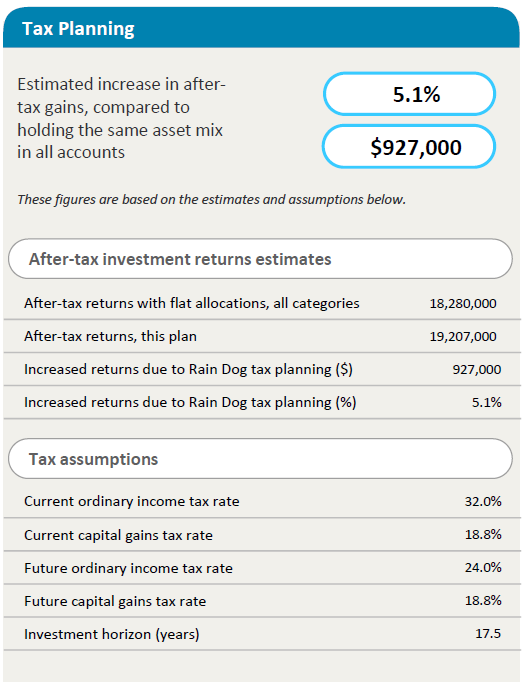
Careful asset location allows Brian and Grace to increase their after-tax returns significantly without changing their overall portfolio and without increasing their risk exposure. This is essentially free money to Brian and Grace; it just requires a little work on the part of their advisor.
Important: This analysis contains numerous assumptions, which might or might not be true over Brian and Grace’s investment horizon. Assumptions include current and future federal and state tax rates, Brian and Grace’s current and future income levels, and tax efficiency of each specific asset.
I could say, “If reality departs from the assumptions, Brian and Grace’s results could be different or worse than shown here.”
In reality, over Brian and Grace’s 17.5 year investment horizon, reality is virtually guaranteed to depart from these assumptions. As such, these numbers are not to be taken literally as standalone numbers, but directionally and comparatively, for sake of evaluating different planning options.
Scenario 2: Sarah and Mark Lindholm
You can see Sarah and Mark’s full investment tax-location plan here.
Sarah and Mark are both age 59, live in Redmond, WA, and have total investment assets of approximately $7 million. Of those, Rain Dog directly manages $4.1 million, including $518,000 in Roth IRAs, $1.3 million in traditional IRAs, and $2.3 million in taxable accounts.
There are multiple constraints in managing Sarah and Mark’s portfolio. Mark is still working and has almost $1 million in his current employer’s 401(k). Rain Dog can advise that but cannot directly manage it. The household also has $875,000 in taxable, low-cost-basis Amazon stock and $580,000 in taxable low-cost-basis Starbucks stock. In addition, the household has $528,000 in other taxable investments that, for various reasons, cannot be changed.
In this case, Sarah and Mark’s tax-deferred account is populated with four assets:
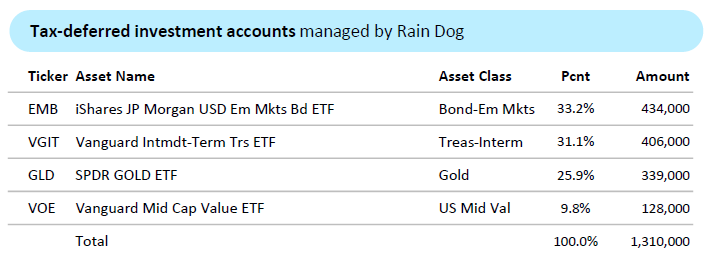
In this case, we were able to place all of Sarah and Mark’s bond funds into tax-deferred accounts. The gold ETF is taxed as a collectible, so it also goes into the tax-deferred location.
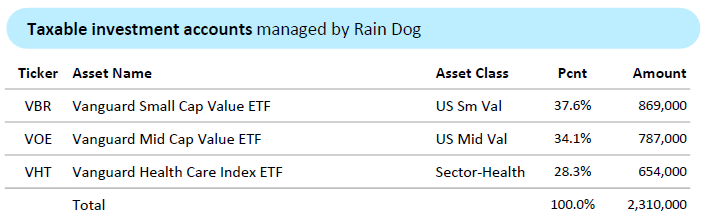
The Vanguard Mid-Cap Value ETF would ideally be placed in taxable or tax-free accounts, so why is it placed in their tax-deferred account? Because there was no more capacity in their taxable account, as shown here:
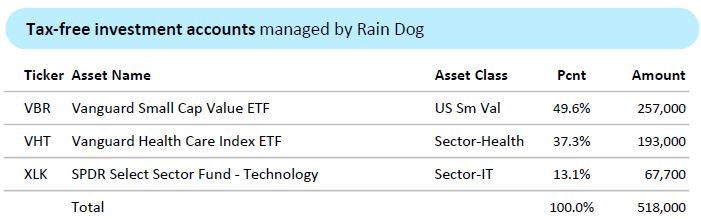
The Vanguard Mid-Cap Value ETF could have been placed in the Roth account, but, overall, the portfolio was more tax-efficient with these three assets in the Roth account:
Results of intentional tax location
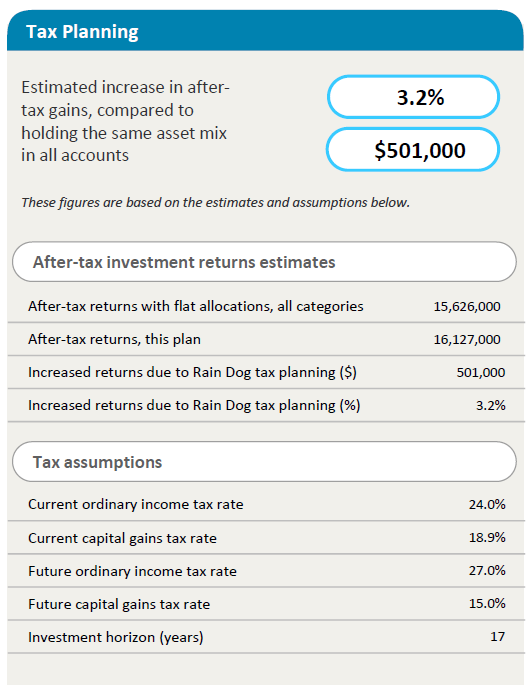
In this scenario, our analysis estimates that Sarah and Mark will gain an additional 3.2% in after-tax investment value over their 17-year investment horizon, as shown here:
Worth noting is that Sarah and Mark’s positions in Amazon and Starbucks stock are arguably over-concentrated. Over time, those positions may be reduced (as tax-efficiently as possible, of course). Diversifying those holdings may create opportunities for further tax-location optimization.
Scenario 3: Heather Anderson
Heather is a self-employed, single, 49-year-old. She has total investment assets of $1.8 million, all of which is managed by Rain Dog except for $65,000 in a 529 plan. She has about $1.3 million in her Solo 401(k), $199,000 in her Roth IRA, and $253,000 in taxable investments.
Heather lives in a state with a 5% state tax rate on the taxable income reported on her federal tax return. Heather prefers a conservative investment approach, so her account is almost 50% allocated to bond funds.
Heather has a long investment horizon (25.5 years), and the only significant constraint on her asset locations is the capacity that exists in each location.
Heather’s asset location plan
You can see Heather’s full asset location plan here.
Heather’s plan is straightforward. The four highest growth assets go into the Roth IRA. Tax-inefficient bond funds and a gold ETF go into her Solo 401(k). Her taxable account doesn’t have enough capacity to take all of the equity funds that remain after filling her Roth IRA, so the most tax-efficient equity funds go into her taxable account; the remainder of the equity funds go into her Solo 401(k) along with the bonds and gold ETF.
Results of intentional tax location
Rain Dog’s analysis estimates that Heather will realize 5.5% more after-tax value over her 25.5-year investment horizon through careful asset location, as shown here.
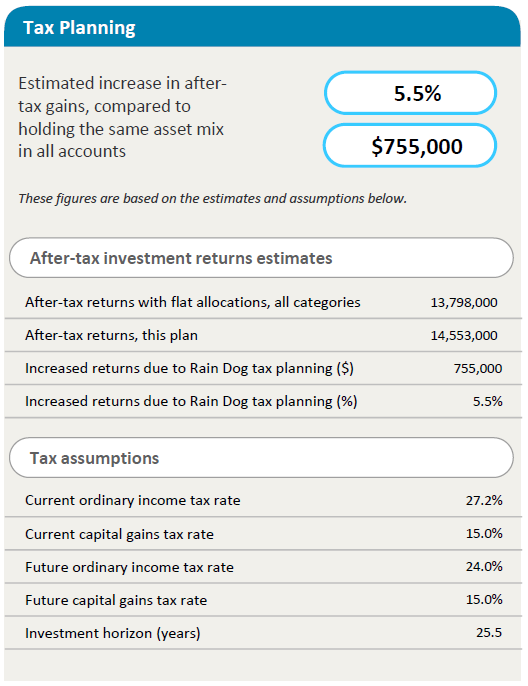
As before, if Heather’s reality departs from the assumptions shown, her results could be different or worse than shown here.
Scenario 4: Neil and Kara Shah
The last household we’ll review is Neil and Kara Shah. They are both in their mid-50s and live in Kirkland, WA. They have investment assets of $4.7 million. Both are still working and have 401(k)s with their current employers, so Rain Dog directly manages $3.4 million and advises how they invest the remaining $1.3 million.
The Shahs have not established any Roth accounts, and relative to their total assets, they have only $635,000 in IRA assets that can be directly managed by Rain Dog.
Neil and Kara’s asset location plan
You can see Neil and Kara’s full asset location plan here.
In their 401(k) plans, the Shahs prefer to be invested in target date ETFs. That decision ripples into Rain Dog’s planning for the investments we manage. As in the other scenarios, the most tax-inefficient bond funds are placed in their IRAs, but their total bond allocation is large enough, relative to the capacity in their IRAs, that some of the bond investment must be put into their taxable account.
Results of intentional tax location
Rain Dog’s analysis estimates that Neil and Kara will realize 1.2% more after-tax value over their 22-year investment horizon through careful asset location, as shown here.
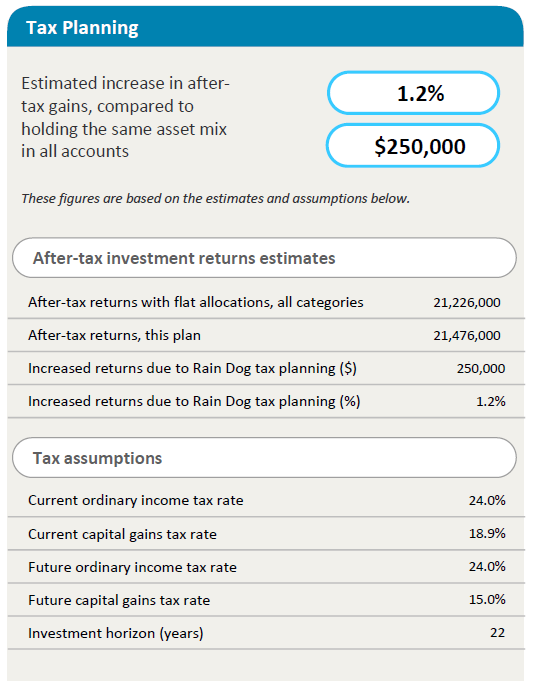
After-tax gains are modest compared to the other scenarios because the Shah’s allocations are constrained by not having any Roth accounts as well as by having relatively low capacity in their IRAs relative to their overall portfolio. Nonetheless, the after-tax gain of 1.2% still amounts to a free lunch in terms of increasing after-tax returns without changing investment risk; the reward is worthwhile compared to the effort required to do explicit asset location planning.
The free lunch isn’t peanut butter
Tax location planning can increase after-tax returns simply by putting carefully selected assets in the most tax-efficient locations. The magnitude of the gains from tax planning varied significantly across the four scenarios, but what didn’t vary was that tax-location planning was worthwhile. There were no scenarios in which a peanut-butter-spread location plan performed as well as the more specialized plan.
I’ve been surprised that none of the plans I’ve reviewed from major firms have included this type of planning. The plans I’ve reviewed from these firms is not a scientific sampling, but I believe every financial planning client deserves this level of planning—and a lot more. If you aren’t receiving this kind of planning from your current advisor, let’s talk about whether there are similar opportunities in your portfolio.
Important information about this Field Note. The households described in this Field Note are fictional. Their circumstances are illustrative and do not represent actual Rain Dog clients or actual client results. The after-tax gains shown are estimates. They are produced by Rain Dog’s asset location model using assumptions about future returns, tax drag, tax rates, income, and investment horizon; actual results will differ, possibly materially. The estimates are intended for comparing planning options, not as predictions or guarantees of future performance. Past performance is not a guarantee of future results, and tax laws and rates may change. This Field Note is for informational purposes only and does not constitute individualized investment, tax, or legal advice. Asset location recommendations depend on each household’s specific circumstances.
Tax-drag data used in calculations is from YCharts. Historical return data is from Morningstar, Yahoo! Finance, and YCharts.
